Not Every Ancestor Belongs at the Table: How to Work with the Wise and Benevolent Ancestors
An article by Dina Tibbs
Friend
You do not need to be a medium to connect with your ancestors.
You do not need to see spirits, hear disembodied voices or receive unmistakable signs from the beyond. You do not need elaborate tools, a perfectly curated altar or someone else standing between you and those who came before you. Ancestral relationship is not a rare supernatural gift bestowed upon a special few. It is one of our oldest human inheritances.
We are already in relationship with our ancestors. They live in the recipes we cook without measuring, the songs that stir something we cannot explain, the shape of our hands, the fibers we weave or knit, the ways we love and the patterns we are trying to change. They are present in our instincts, our longings, our resilience and sometimes in the wounds we inherited without knowing their names.
The work is not necessarily to “make contact.” It is to become quiet enough to notice the relationship that already exists.
This Is Not Just Halloween
Across cultures and centuries, people have created ways to remain in relationship with the dead. These traditions do not share one origin or cosmology, and we should not flatten them into a single vaguely mystical “season of the ancestors.” Yet they reveal something profoundly human: we have long understood that remembering the dead is part of tending the living.
In Gaelic tradition, Samhain marked the end of the harvest and the beginning of the darker half of the year. In the Christian calendar, November 1 became All Saints’ Day, followed by All Souls’ Day on November 2. In Mexico and parts of Central America, Indigenous traditions of honoring the dead mingled with Spanish Catholic observances to become Día de Muertos—a vibrant and distinct tradition centered upon remembrance, offerings and the continuing relationship between the living and the dead. These practices have touched and influenced one another through history, but they are not interchangeable versions of the same holiday.
This season also lives deeply within my own Southern Italian and Mediterranean lineage.
Throughout Southern Italy, Ognissanti—All Saints’ Day—and the Commemorazione dei Defunti, the Commemoration of the Dead, have traditionally been times for visiting cemeteries, cleaning and decorating graves, lighting candles, attending Mass and preparing foods connected with those who have died. Customs vary from one region, village and family to another, as they always do in Italy. We can barely agree on how to make Sunday sauce, so naturally the dead have regional preferences too.
In parts of Calabria and elsewhere in the South, families once left bread, water, wine or an entire place at the table for returning souls. In more modern times we call this the Silent or Mute Supper and we set them a place and often eat together without speaking. Across Puglia, Sicily, Calabria, Campania and other regions, special foods made from wheat, beans, chickpeas, nuts, fruit and honey connected remembrance with the agricultural cycle. These were foods of burial and germination, death and nourishment—the same seed holding both an ending and a beginning.
In Sicily, La Festa dei Morti was not intended only as a solemn occasion. Children might awaken to discover sweets, fruit or small gifts said to have been brought by their dead relatives. The tradition taught them that the ancestors remained part of the family—not merely as frightening ghosts, but as loving presences who still participated in the life of the household. Remembrance was braided together with sweetness, generosity and continuity.
This is a very different relationship with death from the one many of us inherit in modern American culture, where the dead are quickly removed from the home and grief is expected to become private, tidy and brief. Almost every other culture in the world has a different relationship with death and grief than we do. In the older Southern Italian imagination, the boundary between the living and the dead was more permeable. The dead could be prayed for, fed, spoken about, visited and kept within the family story.
This is one reason I place pomegranates outside my home during this season. The pomegranate carries an ancient Mediterranean language of life, death, fertility and return. Its hard outer skin conceals hundreds of jewel-like seeds, reminding us that what appears closed or lifeless may contain an entire lineage within it.
Placed outside my door, the pomegranates become an offering and a threshold marker. They welcome the loving, well and wise ancestors while also honoring the boundary of my home. They say: You who come in love and wish for our healing are remembered here. You who carry harm may remain outside and continue your healing elsewhere.
For me, this practice is not borrowed seasonal theater. It is a way of returning to my own lineage and remembering that food, plants, prayer, family, work and the sacred were never meant to be separate things.
Halloween carries echoes of older harvest customs and relationships with the unseen, but this season is much larger than costumes, candy and plastic skeletons climbing suburban houses. Beneath the modern spectacle is something ancient: the understanding that death belongs to life, memory is a form of relationship and the people who came before us do not entirely disappear.
When the Veil Grows Thin
People often say that the veil between the worlds becomes thin at this time of year. I do not necessarily imagine the veil as a literal curtain that opens on October 31 and closes again promptly on November 1. I experience it as a metaphor for our own increased receptivity.
The trees are releasing their leaves. The gardens are dying back. The light is withdrawing and the nights are lengthening. The natural world is making death, decay and impermanence visible. We are surrounded by reminders that letting go is not a failure of life but part of its rhythm.
Perhaps the veil grows thin because we become quieter.
We come indoors. We gather around fires and tables. We make soups from old family recipes. Certain scents bring back entire rooms and the people who once stood inside them. Rosemary, woodsmoke, simmering garlic or a particular perfume can carry us across decades in a breath. The dead may feel closer because we have slowed down enough to remember them.
Unfortunately, modern life does not make much room for this kind of listening. We carry the noise of the entire world in our pockets. We are continually asked to react, consume, compare and keep scrolling. Even our spiritual lives can become another form of content.
Ancestral practice calls us in the opposite direction. It brings us back to the body, the hearth, the garden and the table. It asks us to put down the phone, prepare food with our hands, speak someone’s name aloud and remember that the sacred has always lived in ordinary things.
The sacred is in washing the bowl before placing it on the altar. It is in lighting the candle, sweeping the floor, slicing the pomegranate and stirring the soup. It is in telling the old story one more time so it does not disappear.
Not Every Ancestor Belongs at the Table
Honoring our ancestors does not mean romanticizing them.
Our lineages contain people who loved fiercely and people who caused harm. They hold healers, protectors, artists, farmers, midwives and storytellers—as well as addiction, violence, silence, prejudice and wounds passed from one generation to the next. Death does not automatically make someone wise.
Not every ancestor belongs at the table.
When I practice ancestral connection, I am not opening the door indiscriminately to anyone who happens to share my bloodline. I call upon the well and wise ancestors: those who are healed enough to offer guidance without asking me to carry their unhealed burdens. I welcome the ancestors who wish for the healing, freedom and thriving of those who came after them.
If your recent family history is painful, unknown or severed through adoption, displacement, enslavement, migration or estrangement, you can reach farther back. Behind every wounded generation are thousands of ancestors whose names have been lost. Somewhere in that long river are people who knew how to heal, protect, create beauty and live in relationship with the land. You do not need to know the names of these ancestors to call on them to support you. They are waiting for you to do so!
You may also feel supported by ancestors of craft, tradition or spirit—the herbalists, teachers, artists, activists or wisdom keepers whose work helped make your own life possible. This does not mean claiming a cultural lineage that is not ours. It means recognizing that human beings inherit through relationship and learning as well as through blood.
Ancestral discernment also reminds us that honoring someone does not require continuing everything they believed or practiced. Sometimes we honor our ancestors by carrying forward their courage, resourcefulness, humor and devotion. Sometimes we honor them by becoming the place where a harmful pattern finally ends.
We keep the recipe and release the shame. We keep the resilience and release the silence. We keep the stories that nourish life and return the rest to the compost pile.
We Have All Been Each Other’s Mothers
My teacher Perdita Finn says, “We’ve all been each other’s mothers.”
She speaks of this as a truth the soul remembers: across the vast mystery of existence, we have birthed, tended, protected and belonged to one another. I highly recommend you read her books Take Back the Magic and Mother of Magic to really deepen into the type of ancestral work I am sharing in this piece.
Whether you understand that through reincarnation, spiritual kinship or simply as a way of imagining our radical interdependence, it carries a powerful ethical invitation. What would change if we treated the people around us as beings we had once mothered—or who had once mothered us?
Perhaps we would become less willing to reduce one another to arguments, identities and online opinions. Perhaps we would remember that every stranger carries grief, ancestry and a story we cannot see. Perhaps we would ask not only what our ancestors can do for us, but what kind of ancestor we are becoming for those who will come next.
A relationship with the dead should make us more present with the living.
It should deepen our care for the Earth, because the soil beneath us is quite literally made from those who lived before. It should make us more attentive to our neighbors, our communities and the other-than-human beings with whom we share this world. If we have all been one another’s mothers, then the whole world is family—not in a sentimental way, but in a way that gives us responsibility.
Asking the Ancestors for Help
Our ancestors survived things we may never fully understand and a lot of things that are repeating themselves, because us humans tend to not learn from history and our ancestors struggles. They lived through migrations, wars, epidemics, childbirth, hunger, persecution, heartbreak and enormous change. They also knew how to celebrate, flirt, feast, sing, make medicine, grow food and begin again.
One day, if we are fortunate, we will become the elders whose stories are told around the table. Eventually, we too will become the ancestors someone calls upon for courage, protection or wisdom. This work therefore asks more of us than remembrance. It asks us to consider how we are living now. Are we becoming people who will leave wisdom rather than wounds behind us? Are we doing the healing our ancestors could not do, so those who come after us inherit more freedom? We do not need to become flawless before we die, but we can choose to become increasingly honest, accountable, loving and whole. Perhaps one of the greatest ways to honor the ancestors is to become a good one.
We can ask for their help.
Ancestral relationship is not a vending machine where we deposit a candle and request a new job by Friday. It is a relationship built through attention, reciprocity and time. Begin by speaking their names aloud. Introduce yourself, even though they know who you are. Name the ancestors you welcome and establish clear boundaries around those you do not. Ask for their permission to work with them. They may say no because they may not be ready or healed.
You might say:
I welcome only the well and wise ancestors who come in love and who support the healing and flourishing of this family. May all others remain at a distance and receive whatever healing they need elsewhere.
Then ask for help with something specific. Ask for courage before a difficult conversation. Ask for guidance as you parent differently, lead your business, care for an elder or interrupt an inherited pattern. Ask to remember a skill that has been lost. Ask for help seeing what you cannot currently see.
Then listen.
The answer may not arrive as a voice from the rafters. It may come through a dream, a remembered phrase, an unexpected conversation or a strong impulse to make a particular recipe. It may arrive as the calm realization that you already know what must be done.
We remain responsible for our judgment and our choices. The ancestors can advise us, but they do not get to commandeer the wagon.
Creating a Simple Ancestral Altar
An altar is a place where attention gathers. It does not need to be elaborate, expensive or publicly displayed. A small shelf, windowsill, dresser or corner of a table is enough.
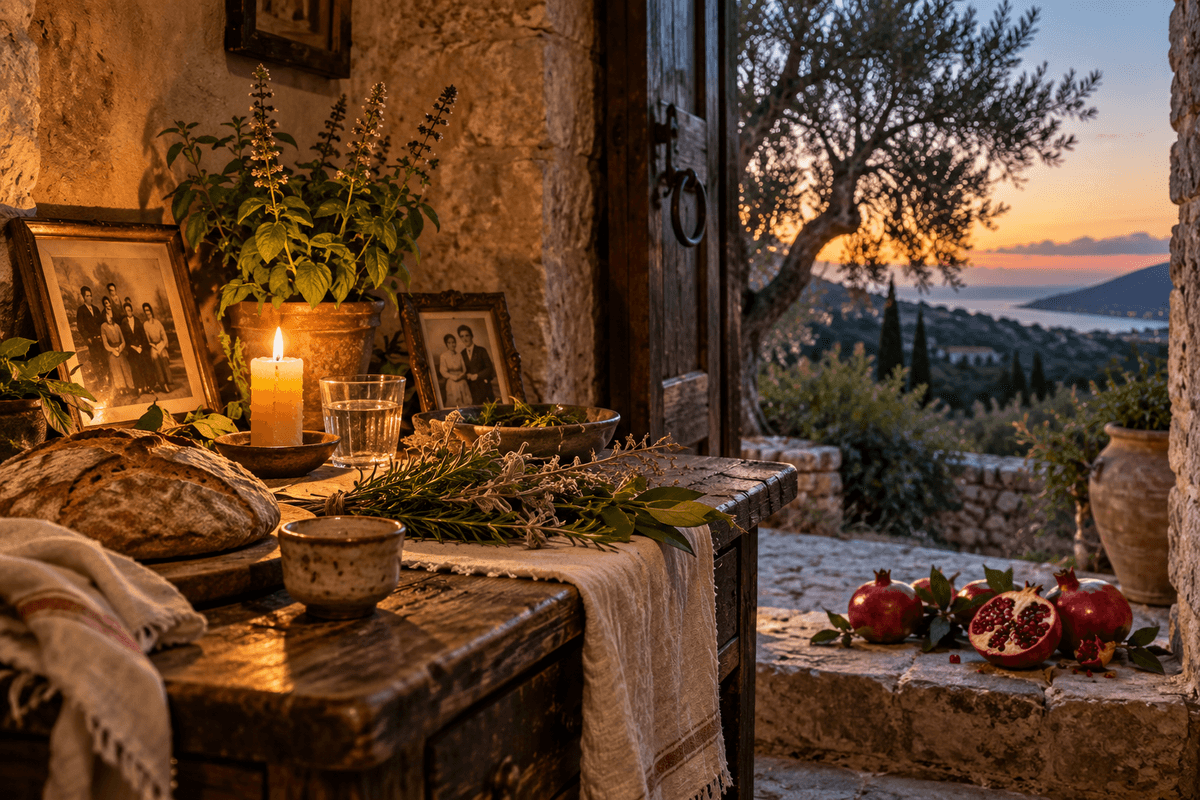
Begin by cleaning the space. Place a cloth beneath the objects if that helps distinguish it from ordinary household clutter. Add photographs or written names of people you wish to remember. If you do not have names or photographs, place an object that represents your lineage: a cooking spoon, a piece of jewelry, a stone from your homeland, a family recipe or a simple candle for those whose names have been lost. I love adding the funny or quirky things like my grandmother’s cat shaped glasses that were the trend when I was a baby. Sometimes it is a pack of Kool cigarettes that represent my father.
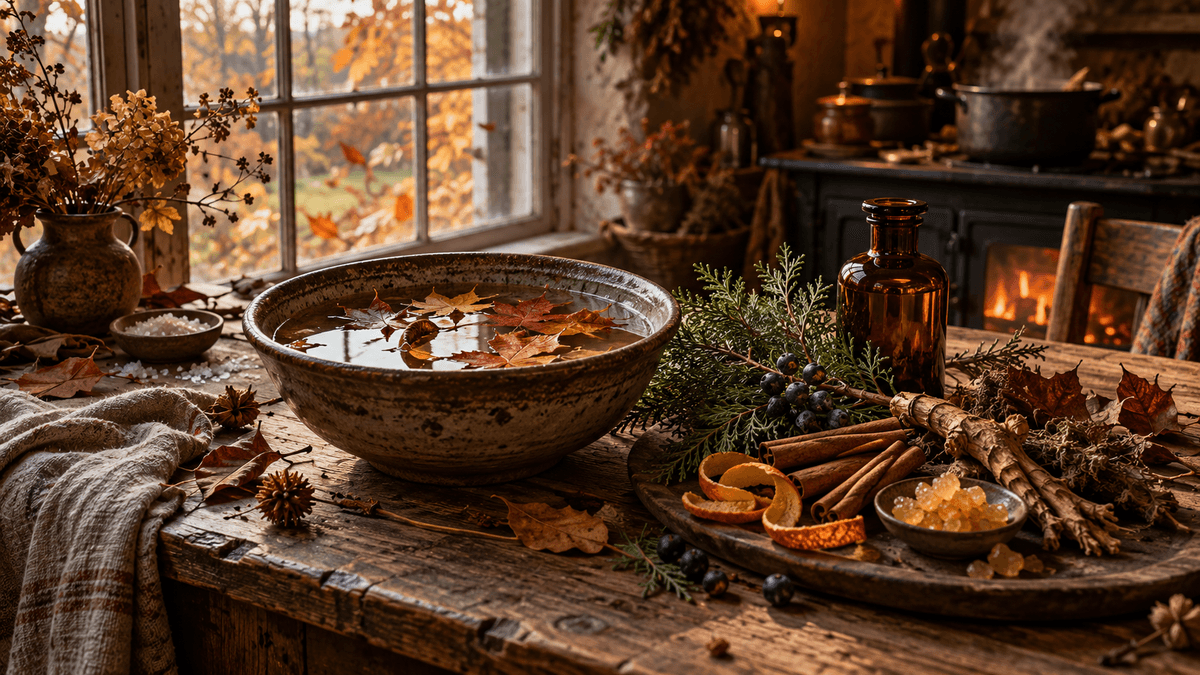
Offer a glass or bowl of fresh water. Water carries memory, emotion and relationship. I normally add Sicilian sea salt to my water. Or my plant allies like Bay and Rosemary. Keep this bowl fresh so it doesn’t get stagnant.
You might add bread, fruit, coffee, wine or a small portion of a meal your loved one enjoyed. Offerings need not be large. Their meaning comes from the relationship and attention placed within them. Afterward, return biodegradable offerings to the earth when it is safe and appropriate to do so.
Each year, I place pomegranates outside my home. The pomegranate is a Mediterranean symbol of fertility, death, rebirth and passage between worlds. Its many seeds remind me that a lineage contains innumerable lives, most of whose names we will never know. Placed outside, it becomes both an offering and a marker of the threshold: gratitude for those who protect and guide the household, and a clear boundary around what may enter.
Light a candle if it is safe to do so. Sit for a few minutes without trying to manufacture an experience. Speak, pray, listen, read a meaningful poem or passage from a book or simply remember. Relationship is built through showing up, not through producing spiritual fireworks on demand.
When you are finished, thank the ancestors, extinguish the candle and deliberately close the practice. The altar may remain, but the ritual has ended. Boundaries are sacred too.
Plants for Remembrance, Protection and Ancestral Connection
Plants have long accompanied people at thresholds: birth, marriage, illness, death and burial. They help us create atmosphere, awaken memory and return spiritual practice to the sensory world. They can be placed on the altar, brewed as tea, added to food or baths, carried as talismans or worked with through scent. Not every plant needs to be burned—and not every meaningful encounter with a plant requires ingesting it.
Rosemary: Remembrance and Continuity
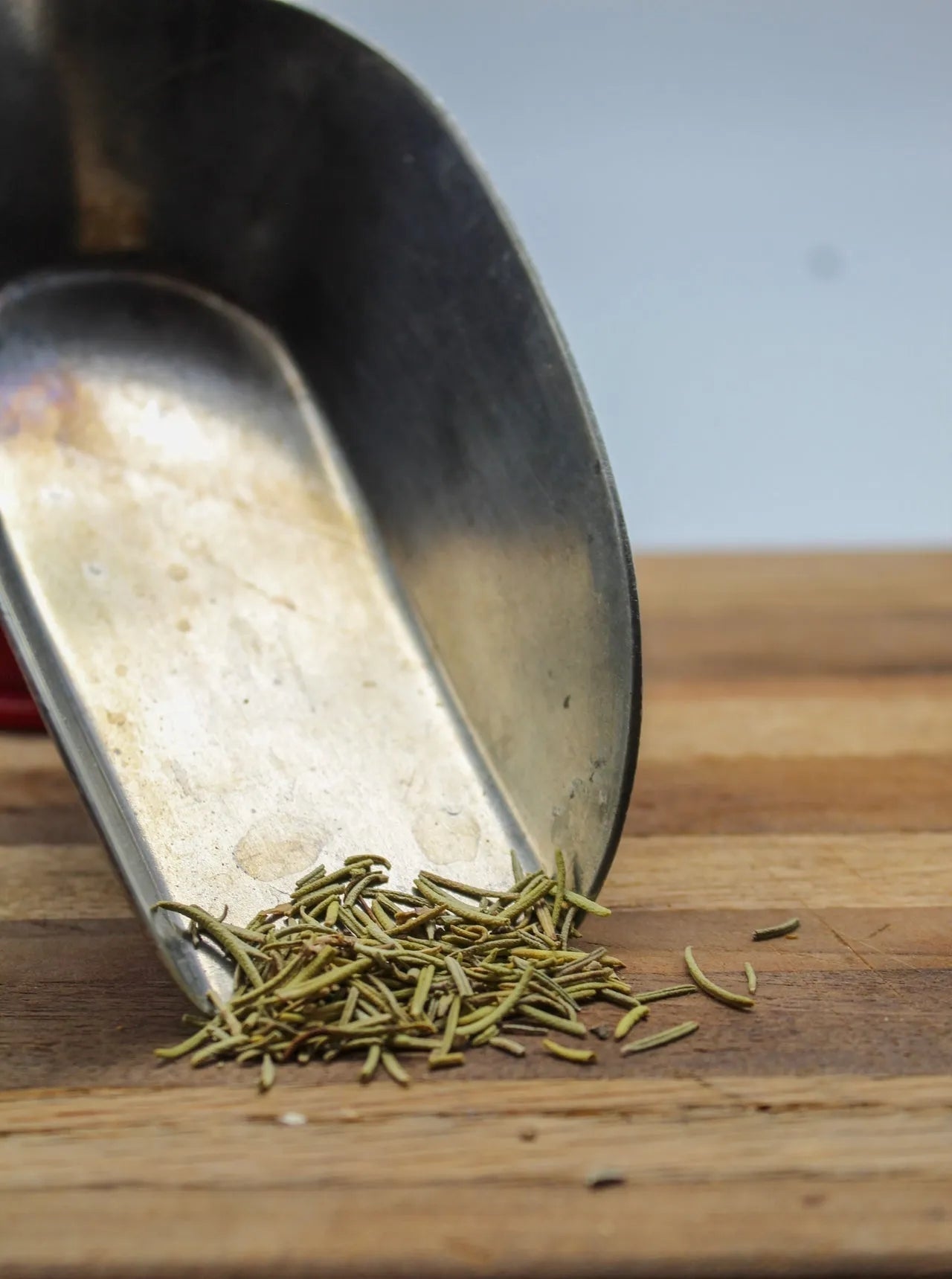
Rosemary (Salvia rosmarinus, formerly Rosmarinus officinalis) has been connected with remembrance, mourning and protection throughout Mediterranean and European traditions. Its evergreen nature speaks of continuity: life persisting through the dark season and memory remaining alive after death.
Place fresh or dried rosemary on the altar, weave it into a small wreath or add it to a remembrance bath. Simmer it gently with citrus peel to scent the home, or cook with it while preparing a family meal. As you strip the leaves from the stem, speak the names of those you wish to remember.
Rosemary helps us remember without becoming trapped in the past. It asks: What deserves to remain alive through me?
Mugwort: The Plant at the Threshold
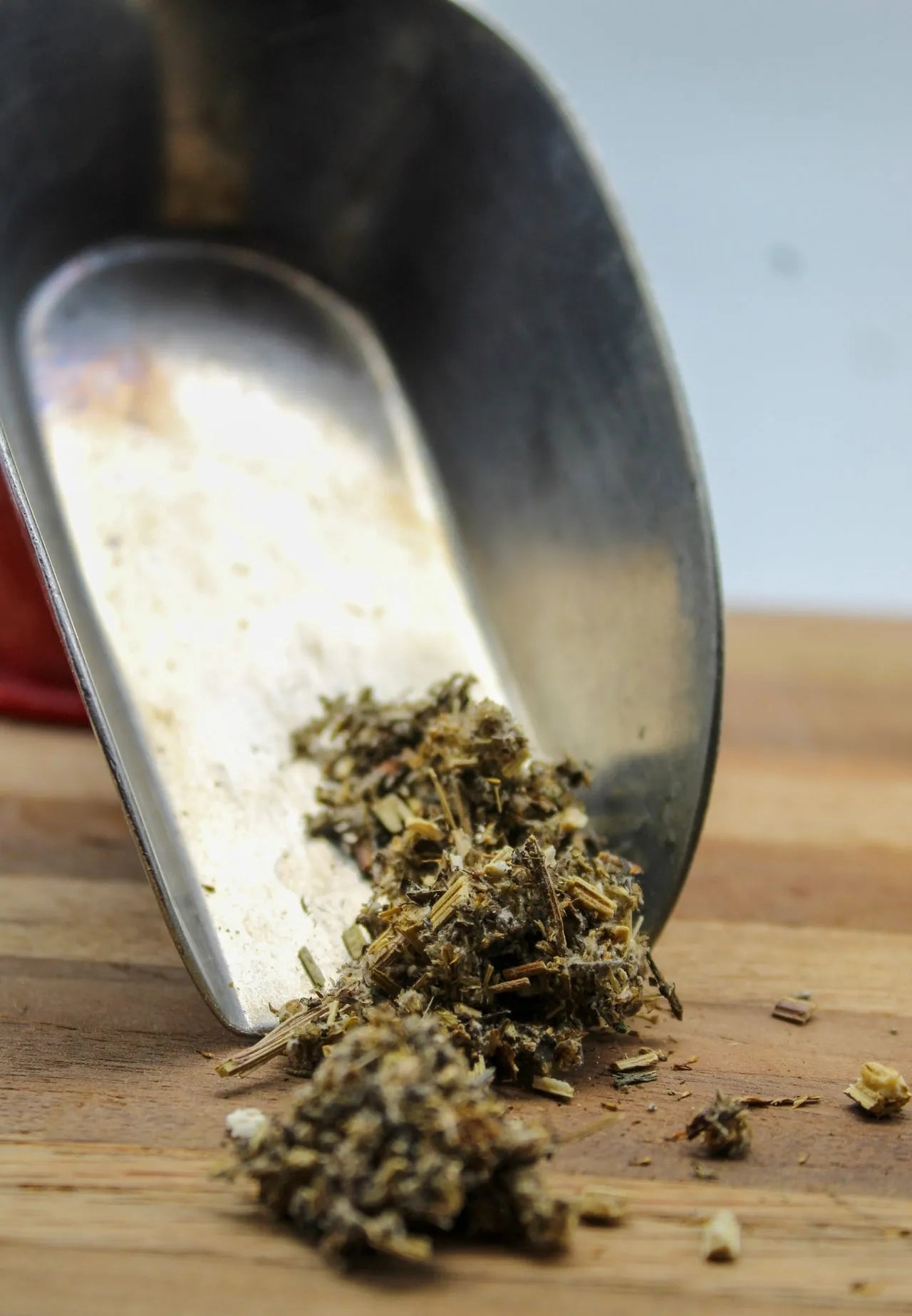
Mugwort (Artemisia vulgaris) is a plant of dreams, intuition, liminal spaces and the unseen. She is often associated with divination and the ability to travel between ordinary awareness and the imaginal world.
Place mugwort near the altar or tuck a small amount into a dream pillow before sleep. You might drink mugwort tea if it is appropriate for you, but ritual use does not require internal use. Mugwort should be avoided during pregnancy, and those with sensitivities to plants in the Asteraceae family should use care.
Because mugwort opens perception, I pair her with a plant of protection and clear boundaries. Opening is not the same as discernment. The goal is not to become psychically porous; it is to listen wisely.
Bay Laurel: Prophecy and Clear Questions
Bay laurel (Laurus nobilis) is one of my own plant allies. In the ancient Mediterranean world, bay was associated with prophecy, protection, purification and sacred achievement. Its presence feels bright and clarifying rather than dreamy.
Place several leaves on your altar or hold one while considering the question you wish to bring to your ancestors. Write the question in your journal, then place a bay leaf between the pages while you listen over the following days. Bay can also be added to a simmer pot or, most naturally, to the soup or sauce you prepare as an offering.
For me, bay is less about predicting the future than becoming clear enough to recognize what I already know.
Holy Basil: Sacred Presence and Resilience
Holy Basil or Tulsi (Ocimum tenuiflorum) is revered within Hindu and Ayurvedic traditions as a sacred plant associated with protection, devotion and the presence of the divine. It is not traditionally interchangeable with European ancestral herbs, and I want to honor the culture from which its sacred uses arise rather than casually annexing it into a generic Samhain practice.
Tulsi belongs here because ancestral work can stir grief, family trauma and old nervous-system patterns. Human research suggests that standardized Tulsi preparations may support the body’s response to stress, although that is different from claiming that the plant can erase inherited or epigenetic trauma.
A cup of Tulsi tea before journaling or sitting at the altar can help create a ritual of steadiness and presence. It can accompany us while we choose a different response, speak what was once forbidden or practice becoming the ancestor we needed.
Tulsi does not do the healing work for us. She may, however, sit beside us while we do it.
Pomegranate: An Offering at the Threshold
Pomegranate (Punica granatum) carries an ancient Mediterranean language of fertility, death, regeneration and return. Its many seeds remind us that our lineage holds innumerable lives, most of whose names have been lost.
Each year, I place pomegranates outside my home as an offering to the well and wise ancestors and as a marker of protection. The gesture welcomes relationship without abandoning discernment. The doorway is a place between worlds, but it is also a boundary. Not everyone who once belonged to the family is automatically invited into the intimate life of the household.
You might place a whole pomegranate outside your door, add one to your ancestral altar or open the fruit and share some of its seeds in remembrance. As you do, consider the gifts hidden within your own lineage—and what is ready to be returned to the earth rather than carried forward.
Finding the Sacred in the Mundane
Our ancestors did not necessarily separate spiritual life from ordinary life in the way modern culture often does. The sacred lived in bread-making, planting, harvesting, washing the dead, tending the fire and gathering around the table.
We can reconnect with them by doing ordinary things with full attention.
Cook a family recipe. Mend something rather than replacing it. Learn the names of the plants growing near your home. Step outside without your phone. Sweep the floor as though preparing it for honored guests, my grandmother always swept the floor to clear energy out of the house. Sometimes at 2 AM when she couldn’t sleep. Tell the children a story about someone who came before them. Sit beneath a tree old enough to have witnessed several generations of human worry and notice that it is not checking the news.
These practices reconnect us not only with our ancestors, but with nature and ourselves. They pull us out of the online chaos and return us to a slower form of intelligence—one shaped by seasons, bodies, relationships and place.
This is how the sacred returns: not always through grand revelations, but through attention.
Questions for the Ancestors—and for Yourself
Bring these questions to your altar, your journal or a quiet walk:
- Which ancestors feel safe, loving and wise enough to invite closer?
- What gifts have traveled through my lineage?
- What patterns am I ready to stop carrying?
- What family story needs to be remembered differently?
- What skill, recipe, song or practice wants to be restored?
- Where am I being asked to choose courage over inherited fear?
- What help do I need—and have I actually asked for it?
- What would the well and wise ancestors want for my life?
- If we have all been each other’s mothers, how am I being asked to treat the living?
- If my descendants someday tell stories about me and ask me for guidance, what kind of elder and ancestor do I want them to remember—and what must I begin practicing now to become that person?
- What wisdom am I cultivating that will be worth passing on?
You do not need proof that your ancestors heard you. You do not need a dramatic sign. Begin with attention, sincerity and clear boundaries. Set the table. Pour the water. Place the rosemary, light the candle and speak their names.
Then go live in a way that gives their best wisdom somewhere to land.
This post was published